
The Nazis Landed in North America – Wetter-Funkgerät Land
Updated 28/04/2026
During World War II, the Kriegsmarine focused almost entirely on building U-boats to disrupt the Allied supply lines from America to England.
Nazi Germany constructed a massive fleet of U-boats, 1,162 in total between 1935 and 1945. During the war, 784 U-boats were lost due to improved Allied technology, such as radar, sonar, the breaking of the Enigma code by Bletchley Park in England, better convoy escorts, and Allied air superiority over the Atlantic Ocean. The casualties among U-boat crews were also high: approximately 75% died, about 30,000 of the 40,000 crew members.
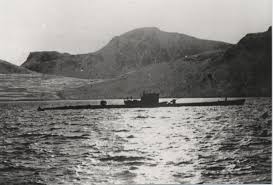
The U-537
The U-537 was a Type IXC/40 U-boat of the Kriegsmarine. It was built in April 1942 by Deutsche Werft in Hamburg. The submarine was commissioned on January 27, 1943, under the command of Peter Schrewe, who led it for nearly two years until its loss in Asia.
The Type IXC/40 U-boats were slightly larger than the original Type IXC. The U-537 had a total length of nearly 77 meters and a height of almost 10 meters. Two MAN nine-cylinder diesel engines produced 4,400 horsepower for surface propulsion, and two Siemens-Schuckert electric motors of 1,000 horsepower each for underwater propulsion. The boat could dive to a depth of 230 meters. Its maximum speed was nearly 34 km/h on the surface and 13.5 km/h submerged. The U-537 was equipped with six torpedo tubes, 22 torpedoes, and anti-aircraft guns.
Landing in North America
What made the U-537 so unique? It is the only U-boat to have completed a mission in North America. Nazi Germany thus (albeit on a small scale) carried out a mission on North American soil, and the US never knew about it. The U-537 left Bergen, Norway, on September 30, 1943, with the mission to set up an automatic weather station, codenamed “Kurt,” in Martin Bay, Labrador, Newfoundland. From 1934, the area was formally under Newfoundlands/British authority until 1949, within the Dominion of Newfoundland. From 1949 onwards the area became part of Canada.
On the return journey, the U-537 was attacked from the air with rockets on October 31, all of which missed their target. On November 10, it was attacked again with depth charges. The boat escaped unscathed, but the next day, another air attack caused minor damage. Surface ships then pursued the U-537 but failed to locate it. The U-537 finally arrived safely in Lorient, Brittany, on December 8.
The Weather Station
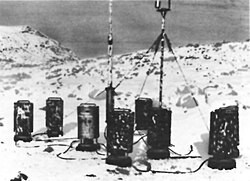
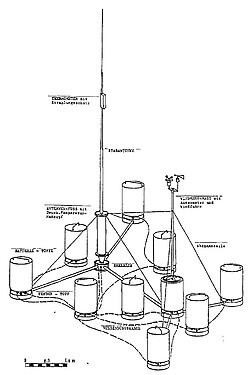
The network of weather stations in North America, Greenland, and Iceland provided the Allies with more accurate weather forecasts than the Germans could access. To obtain better weather data, the Germans developed an automatic weather station, the Wetter-Funkgerät Land. Siemens built 26 of these systems. Each consisted of 10 cylindrical containers housing various measuring instruments and batteries, with one container connected to a 10-meter antenna mast. The system was powered by nickel-cadmium batteries, which could keep it operational for six months. Solar panels were not yet available at the time.
Fourteen weather stations were placed in Greenland, Bear Island, Spitsbergen, and Franz Josef Land, and five were installed around the Barents Sea. Two were reserved for placement in North America, but the U-867 was sunk by depth charges in September 1944 during a British air attack. The U-537 did reach its destination, and on October 2, the U-537 arrived in Martin Bay. En route, it had encountered a storm and sustained significant damage, including hull leaks and the loss of its anti-aircraft gun.
Within an hour, a reconnaissance team found a suitable location, and an installation team left the U-537 to set up the weather station. Other crew members worked to repair the hull damage. The weather station was camouflaged, and packs of American cigarettes were left behind to mislead any potential discoverers. One of the containers was labeled “Canadian Meteor Service.” Both teams worked through the night to install Kurt and repair the boat. In 28 hours, the mission was completed, the system was checked, and the U-537 departed.
Kurt’s weather data from enemy territory was used to determine whether aircraft could take off or not, whether there was ice formation, and whether an attack could be carried out or not.
The weather station operated for a few days, then the signals weakened, and the system finally stopped after three weeks.
The weather station was forgotten until 1977, when geomorphologist Peter Johnson discovered it (a geomorphologist is an earth scientist who studies the forms of the earth’s surface). He thought it was a Canadian military installation and named it “Martin Bay 7.” In 1981, a team from the Canadian Department of National Defence visited the site and found the remains of the system. Weather Station Kurt is now part of the Canadian War Museum in Ottawa.
Sources:
Wikipedia – Weather Station Kurt
Wikipedia – U-537
14:29