
Updated 22/06/2026
The Geneva Convention is a collective term for the treaties drawn up in Geneva and which, as part of humanitarian law, determine the rules of law during an armed conflict. The treaties have been signed by all countries in the world.
First version 1864
Improving the fate of wounded and sick forces on the ground
Second version 1868
Improving the fate of wounded and sick armed forces on the ground, supplemented by improvement of the fate of shipwrecked forces of armed forces at sea
Third version 1929
Specifically the treatment of prisoners of war in conflicts
Fourth version 1949
Specifically the protection of civilians in wartime
A number of protocols were added in 1977, which were not signed by all countries:
Protocol 1 – specifically the protection of victims of international armed conflict in wars between different countries
Protocol 2 – specifically the protection of victims in non-international armed conflict, in which one or more armed groups fight against a country
Provisions
The main provisions for the treatment of prisoners of war are:
Be treated humanely and with respect
Clothing, eating utensils and personal items may be retained
Plenty of food and clothing
Provide medical and mental care if necessary
Being released and repatriated when hostilities have ended
The practice
The list of war crimes during World War II, both against civilians and against military personnel, is led by Nazi Germany. The list is very long and as far as citizens are concerned, the story about the Murder factories on this site is very clear. The atrocities in Operation Barbarossa of both the Germans and the Russians and specifically the Battle of Stalingrad are unimaginable. Despite the fact that Hitler had concluded a non-aggression treaty with Stalin, the Wehrmacht, probably blinded by the successful Blitzkrieg advance in the West, proceeded to the attack on Russia, with in the slipstream the Einsatzgruppen who had to purge the conquered territories of people of various plumage, who were no longer wanted. In the beginning, Operation Barbarossa went very well and Russia threatened to be overrun by the Germans, but when the winter fell in, the advance was almost brought to a halt due to the bad weather, the mud and faltering logistics. The Einsatzgruppen ensured that captured Russian soldiers and civilians were transported to the concentration camps. With the rules of the Geneva Convention, the Germans had nothing to do with it.
When the tide turned and the Russians fought back from a completely hopeless situation, the Russians took revenge on the crimes committed by the Germans. The atrocities in “the kettle” at Stalingrad were horrific. Tanks drove up and down in “the kettle” over everything and everyone they encountered, including over wounded Russian soldiers who could not get away in time. On the way to Berlin, the Russians were unstoppable and they also committed the most terrible atrocities on German soldiers and civilians. The Russians also did not have much on the rules of the Geneva Convention.
In addition to Germany and Russia, the actions of the Japanese after the Doolittle raid on Tokyo and the revenge on the citizens of the Chinese town of Quzhou, which had helped the Americans in the attack, were of an unprecedented cruelty. Many times worse than the usual Japanese atrocities in the territories they conquer. More details on this in the chapter on Unit 731 in the story of the attack on Pearl Harbor. Furthermore, there are war crimes against prisoners of war: Nanjing massacre, Bataan death march, Enemy airmen’s act, Parit Sulong, Laha, Palawan and Changjiao massacre. Japan, too, had never heard of the Geneva Convention.
Stalag

The Germans had set up a large number of prison camps for enemy men and petty officers, the Stalag, short for Mannschaftsstamm- und Straflager. The Stalags fell under the authority of the Algemeine Wehrmachtsambt under the leadership of Hermann Reinecke, later under the leadership of the Waffen-SS general Gottlob Berger. In the Stalag, starvation was deliberately applied, especially among the Russian prisoners. A number of camps consisted of a field with barbed wire, where thousands of people were arrested. Impossible to sit or lie down. There was no shelter from the winter conditions and there was too little food. The death rate among Russians was 57.5%, but later became much higher. Among the Western Allies, the mortality rate was below 5%.
Types of Stalag :
Dulag – Durchgangslager
Stalag – Stammlager – prisoner of war camp
Oflag – Offizier-Lager
Stalag Luft – Luftwaffe-Stammlager – for aircraft crews
Milag – Marine-Internierten-Lager, for merchant navy passengers
Marlag – Marine-Lager
Ilag – Internierungslager, a camp for interned enemy nationals.
The Allies versus the Germans
But the Allies also committed atrocities, disregarding the rules of the Geneva Convention. Less well-known is the Biscari Massacre during the invasion of Sicily in July 1943, where 76 German and Italian prisoners of war were murdered. There was also the Salina Massacre, also during the invasion of Sicily, where Private Bertucci used his machine gun to kill 9 prisoners of war and wound 20 others. Additionally, there were instances of American soldiers mutilating the bodies of dead Japanese soldiers and taking limbs and skulls as souvenirs.
The Massacre at the Small Village of Le Paradis, France
The massacre by the Waffen-SS at the small village of Le Paradis took place during the retreat of British and French troops to Dunkirk in May 1940. Soldiers of the 2nd Battalion of the Royal Norfolk Regiment had become isolated from their unit. They had withdrawn to Cornet Farm, a farmhouse that had served as their headquarters, and were ordered to resist for as long as possible to buy time for the Dunkirk evacuation.
Despite an assault involving mortars and tanks by the 1st Battalion of the 2nd SS Infantry Regiment, the British managed to halt the German advance. After running out of ammunition, the British soldiers surrendered. Another German unit, the SS-Division Totenkopf, led by Hauptsturmführer Fritz Knöchlein, gathered the men. They were disarmed and taken to a location near a barn on the farm. While the British waited there, two machine guns were set up. The soldiers were then ordered to stand against a wall, where they were shot down by machine-gun fire. Afterward, the Germans used bayonets to ensure all the British soldiers were dead. Ninety-seven British soldiers were killed.
Miraculously, two British soldiers survived the massacre, hiding afterward, but were captured by German troops a few days later.
In 2007, the remains of 20 soldiers from the Royal Scots Regiment were discovered near the execution site. It is possible they were murdered by an SS unit after surrendering.
After the war, Knöchlein was convicted of the Le Paradis massacre by a British military court, with the two British survivors testifying against him. He was sentenced to death and executed in 1949.
The Graignes Massacre
The Battle of Graignes at the start of the Normandy invasion took place between June 10 and 12, 1944. Paratroopers from the 82nd Airborne Division captured Graignes from the 17th SS Panzergrenadier Division Götz von Berlichingen and held their ground for two days. This action prevented the Germans from immediately launching a counterattack on Carentan.
During the landing on June 6, many paratroopers from the 82nd Airborne Division (507thPIR) were scattered over a large area around Carentan. They landed near the village of Graignes, the biggest misdrop of D-Day. Because the paratroopers were far from their intended drop zone and deep behind enemy lines, they decided to occupy and defend Graignes. Ultimately, 182 paratroopers gathered there.
With the help of the mayor, the villagers of Graignes organized a plan to supply the paratroopers with food and water twice a day. They also collected many supplies that the Americans had left behind.
On the afternoon of Sunday, June 10, a confrontation occurred with a German reconnaissance patrol. Four Germans were killed. Around 2:00 PM, the Germans began a heavy mortar bombardment of Graignes. Despite this attack, the Americans held their ground.
However, at 7:00 PM, the real assault on Graignes began. Two 88mm cannons fired from Thieuville, a few kilometers away, and soon the American defense was largely disabled. The order was given to escape toward Carentan or Sainte-Mère-Église. Eventually, the Germans launched their final attack with 2,000 men, a ratio of 1 to 10 in terms of personnel.
By the end of the battle on June 11, the Germans had recaptured Graignes. An American medical post with 14 wounded GIs—protected under the Geneva Convention—was split into two groups and murdered. One group was killed with bayonets, while the other was shot after being forced to dig their own graves.
The civilians did not escape the Germans’ vengeance either. They were considered accomplices of the Americans. Father Lebastlier, Lebarbanchon, and Madeleine Pezeril with her 8-year-old son were shot dead. The Germans then looted the village.
On June 13, the Germans burned Graignes to the ground. 66 houses were destroyed, including the church. 159 other houses were severely damaged. Only two houses survived the attack.
The surviving paratroopers managed to reach Carentan. Of the original 182 paratroopers, 150 made it out alive by June 16.
Especially during the Ardennes offensive (Wacht am Rhein) a few more remarkable actions have taken place. The massacre at Honsfeld, Büllingen, Baugnez and Wereth by the Germans and the revenge of the Allies at the massacre at Chenogne. Here, too, the rules of the Geneva Convention were forgotten for convenience.
Baugnez massacre
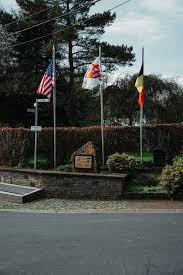
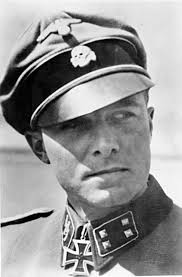
On December 17, 1944, Joachim Peiper with his 1st SS Panzer Division was about 16 hours behind the schedule. Upon arrival in Honsfeld, to the surprise of the Germans, all kinds of vehicles and equipment were on the road. There was no Allied soldier. The American soldiers were all asleep in the village. When they were alarmed by the presence of the Germans, there was little time for a counter-attack. Still, a small unit managed to destroy a number of German vehicles and tanks. After taking Honsfeld, U.S. prisoners of war were murdered as punishment for the counterattack. The bodies were on the street and some were later run over by vehicles.
Peiper then deviated from the intended route to take a small fuel depot at Büllingen. The US 99th Infantery Division was completely surprised, but managed to take out a tank anyway. The smaal airport was quickly conquered, along with 12 reconnaissance aircraft. The fuel depot was also conquered and as much fuel as possible was used to refuel the German vehicles. The Waffen-SS infantry executed 80 U.S. prisoners of war on the spot. This according to tradition, the evidence for this is not available.
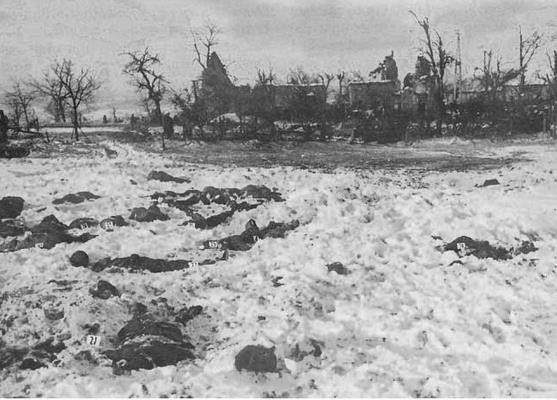
Peiper then went west towards the river Meuse and conquered a number of villages. But due to the poor quality of the roads that the heavy Tiger tanks could not bear, the backlog on the schedule was increasing. At the village of Ligneuville, Peiper had to adjust his route again and did not turn left but turned right towards the intersection of Baugnez. Kampfgruppe Peiper approached the crossroads at Baugnez, a town a few kilometers away from Malmedy. At the same time, from the opposite direction, a convoy of light U.S. Army vehicles from the 285th Field Artillery Observation batalion also approached the crossroads at Baugnez with the aim of joining the 7th Armored division. Peiper saw the Americans first and opened fire. The first and last vehicles were hit, bringing the U.S. convoy to a halt. The Waffen-SS infantry gathered the American soldiers at a field next to the crossroads. A number of previously captured soldiers were also added to the group, totaling some 120 U.S. captured soldiers. Machine guns were drafted and the Americans were mowed down out of nowhere. Most soldiers immediately died, others were released from their misery with a neck shot. Some managed to flee, some hiding in a cafe on the corner at the intersection. The Waffen-SS then closed the café and set the café on fire. Every American who came out was shot. 84 Americans were killed. Despite all this, a number of Americans survived the attack. 43 Survivors reached the Allied forces and were questioned immediately after arriving. Thus, the stories of the German criminal offense reached the American troops, with far-reaching consequences.
Peiper continued his way and a number of massacres of civilians and soldiers followed in Bande, Noville, Stavelot, Bourcy, Houffalize, Cheneux, La Gleize, Stoumont, in the region between Stavelot and Trois-Ponts, in Lutrebois and Petit Their.
Wereth massacre
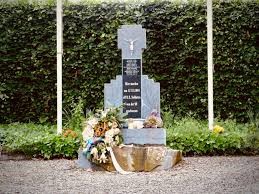
In the wake of the Baugnez massacre, 11 African-American soldiers approached the town of Wereth. The first house was inhabited by Mathias Langer and Mathias offered the soldiers a hiding place. The wife of a German soldier living in the village told the 1er SS Panzer Division that African-American soldiers had been spotted in the village and were hiding at Langer. The SS men captured the Americans and set up the prisoners in a nearby field, where they were beaten, tortured and eventually shot. When the Americans took the area again, they discovered the heavily damaged faces, broken legs, severed fingers and that some had been stabbed with the bayonet. The SS men responsible for the massacre were part of the Schnelle Gruppe Knittel under the command of Gustav Knittel.
Chenogne massacre
The news of the mass execution at Baugnez had since penetrated the American troops. Soon unofficial orders circulated to show no mercy with the Waffen-SS and the Fallschirmjäger at the front. Killing SS prisoners became a custom in some parts of the U.S. military. Late in December 1944, the 90th Infantery Division killed Waffen-SS prisoners in such a systematic way that headquarters had to issue special orders to capture the Waffen-SS soldiers alive in order to be able to question them.
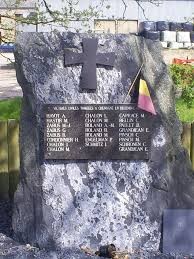
Chenogne, near Bastogne was occupied by the Germans. The battles surrounding Chenogne were very intense. The village was conquered and retaken at least 5 times. Of the 32 houses in the village, only one was spared. 23 of the 36 inhabitants were killed in the fighting.
On January 1, 1945, after a fierce night struggle, the village was retaken by the 11th Armored Division. The day before, the order was issued not to capture Germans. As soon as the Germans, part of the Führerbegleit brigade and the 3er Panzergrenadier-Division emerged from their hiding places, they were killed immediately without warning, despite the fact that they wanted to surrender. A few minutes later, the same thing happened to another 60 soldiers. They were mowed down by machine gun fire in a field near the village. When Eisenhower heard of this, he judged this as a war crime and demanded clarification. But with support from Patton, the incident was covered up. No one was prosecuted for this.
Conclusion
It will be clear that during World War II, the rules of the Geneva Convention were of zero and no value. Even today, the rules are protected, but unfortunately in most cases not adhered to. Again a proof that a part of humanity is delighted in making the other part suffer in the most cruel way.
Source:
Various Wikipedia articles
Liberation Route Europe
The Red Cross Netherlands