
Updated 23/01/2026
Hitler always had a preference for the megalomaniac during WWII. Everything had to be big, very big:
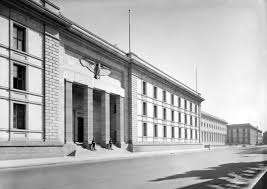
The new Chancellery
The new Reichskanzlei was certainly not small either. Albert Speer had designed this building on behalf of Hitler and it had to be representative of the power of the Führer. State guests and high-ranking visitors entered the building through a bronze door. Above the door the Nazi eagle showed the swastika in its claws. On both sides of the entrance were two colossal bronze statues of muscular men symbolizing the strength of the NSDAP and the Wehrmacht . Once inside, one ended up in a 146 meter long corridor with a marble floor. Hitler’s office had a floor space of 400 square meters and a height of 4.5 meters. The walls were covered with red Austrian marble. Not a humble place in that way.
The Atlantic wall
And let’s not forget the Atlantikwall, a gigantic number of coastal defence batteries (Widerstandsnesten – WN), built by Operation Todt, the defense line from Norway to Spain, with meters thick walls and a large number of underground passages. Imagine the huge mass of concrete used for this.
The tanks
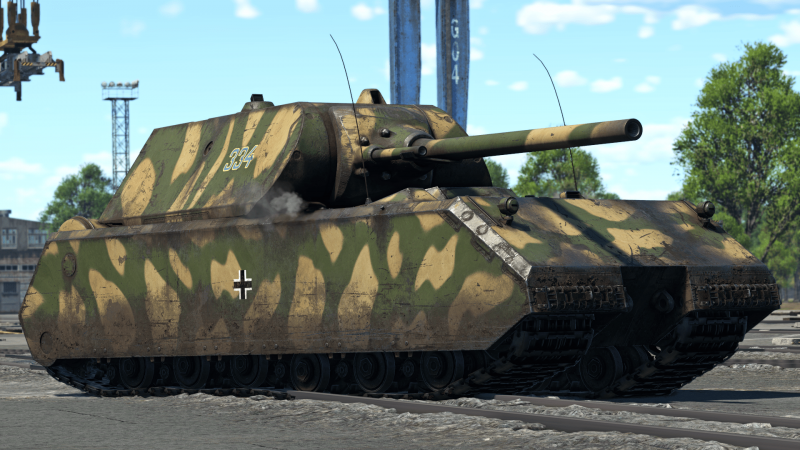
The Panther tank, but even more so the Tiger I, the Tiger II (King Tiger), and the Maus stand out among German armored vehicles. The Maus measured 10 meters in length, 3.7 meters in width, and 3.6 meters in height, with a weight of 188 tons. With a fuel capacity of 2,700 liters, the Maus could travel 160 kilometers on roads and 62 kilometers in rough terrain. Due to its weight, the Maus could cross almost no bridges. In October 1943, Hitler abandoned further production; 150 units had been ordered.
Additionally, there was a German tank project that never progressed beyond the design phase: the Landkreuzer P. 1000 “Ratte.” Weighing 1,000 tons, five times the weight of the Maus, it was to be 35 meters long, 11 meters high, and 14 meters wide. Its main armament was a turret-mounted gun typically installed on German battleships. The design also included an additional 128mm cannon and anti-aircraft guns. Hitler was fascinated by the concept and initially approved the plan, but Albert Speer canceled the project, deeming it impractical and unusable.
The Allied tanks were no match for the German tanks. The Sherman looked tiny next to the Tiger and was certainly outclassed in battle. Converting the Sherman into the Sherman Firefly improved the situation, and with some luck, the Firefly could take out a Tiger. APDS (Armour-Piercing Discarding Sabot) was an advanced type of ammunition used in the Sherman Firefly, specifically designed to penetrate the heavy armor of German tanks. This ammunition was scarce and only used by British and Canadian units. APDS was a “Firefly-winning” type of ammunition that turned the Sherman Firefly into a formidable tank killer against German heavy armor.
The downside of these superior German tanks was the number that could be built in a given time. In the same period, the Allies could produce many more Shermans. So it became a battle between quality and quantity, and in the end, quantity proved stronger than quality. But this was almost the case with everything in the struggle between the Germans and the Allies.
The railway cannon
Schwerer Gustav
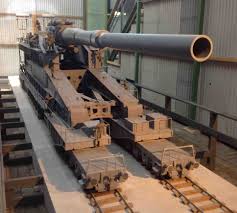
The Schwerer Gustav was the name of three extremely heavy railway guns to be delivered. The cannon was developed in 1930 by Krupp on behalf of Hitler. The gun weighed 1350 tons and was capable of firing 7 tons of heavy armored shells. The range was 38 kilometers, with the lighter high-explosive shell 48 kilometers. The name was later changed to “Dora”. In the autumn of 1941, the cannon was tested as a whole for the first time. A total of 8 shots were fired. The pressure that was released was so great that at the barracks four kilometers away, the windows were broken and the doors burst open.
In early 1942, the gun was used in the battle of Sevastopol and fired 48 rounds. Then the gun was sent to Leningrad but never deployed. Eventually, Dora returned to Rügenwalde and was eventually destroyed.
Because of its enormous weight, the gun could only be used on a specially constructed double track, which of course was not available everywhere. If the gun had to be moved, it had to be completely dismantled and rebuilt at the new location.
The Krupp K5
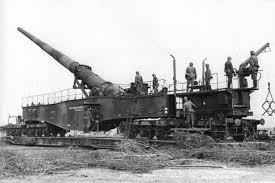
A lighter version was used more. The Krupp K5 was a 280 mm railway gun, also known as the “Schlancke Bertha”. The gun had a length of 32 meters, weighed 120 tons and could fire shells of 255 kg over a distance of 70 kilometers. The cannon was used on almost every front.
A battery consisted of two trains as standard. A train with the weapon itself, there was also a warehouse wagon, a wagon for equipment with kitchen, two wagons with ammunition, two wagons with cartridges for the anti-aircraft guns, an open wagon with the anti-aircraft guns themselves, a flat wagon and three carriages for the men. The second train consisted of three ammunition wagons, another wagon for the equipment, nine wagons with various vehicles, a wagon with shelter, a wagon with anti-aircraft guns, a passenger car and two wagons with attachments for the gun. The unit consisted of 42 men as standard. Furthermore, personnel traveled with them to support the unit, including manning the anti-aircraft guns.
The most famous guns are the “Robert” and the “Leopold” that were used in the landing at Anzio, in defense of the Gustav line. The guns were hidden in a railway tunnel, made ready for fire, driven outside to fire and driven back into the tunnel. The guns thus remained untraceable for the Allies and sowed death and destruction on the landing beaches. The guns were nicknamed “Anzio Annie” and “Anzio Express” by the Allies.
Hitler had ordered the production of 36 units. At least 22 have been delivered. Various versions of the artillery were produced.
The warships
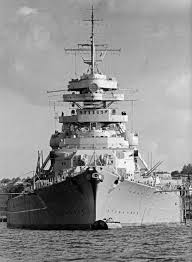
Then the warships, the Bismarck, the Tirpitz, Gneisenau and the Scharnhorst. In a direct confrontation with HMS Wood, the largest English battleship, the Bismarck managed to sink the Wood in no time. The Tirpitz was slightly larger than the Bismarck, a gigantic ship, 50,000 tons of thick armor and 15-inch guns. There was no American or English warship that could take on the Tirpitz one-on-one. The main home port of the Tirpitz, after commissioning in Gdynia (Gotenhafen) were the Norwegian fjords, especially the Altafjord. The Gneisenau and the Scharnhorst had no permanent home base, originally the ships were stationed in Kiel and Wilhelmshaven. The ship’s mission was to sink as many merchant ships as possible from the Allies on the route to the Soviet Union.
Due to their size, these ships had to rely on the port of Saint-Nazaire where a large U-boat base was also built for the 7th Unterseebootsflotille. The port of Saint-Nazaire had a dry dock, the Normandy dock (Forme Ecluse Louis Joubert) of such a size that the large battleships could be repaired. This dock was therefore of enormous strategic importance to the Germans, without it, it was not possible to repair the ships.
The plan, Operation Chariot
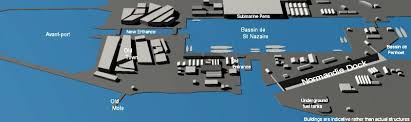
Operation Chariot, also known as the Raid on Saint-Nazaire, was a plan to eliminate this specific dry dock, so that the German battleships there could no longer be repaired. The operation was carried out by Combined Operations under the command of Louis Mountbatten. The Royal Air Force would carry out mock attacks in the area to divert attention, the Royal Navy and 611 commandos would attack the port complex, with the main objective of blowing up the entrance door (caisson) to the dry dock. Planning began in February 1942, and the force finally left on March 26, 1942.
To blow up the drydock door, HMS Campbeltown, an obsolete American warship, was converted to resemble a German Möwe-class destroyer. Below deck, 24 depth charge charges were placed, so that there were a total of 3.14 tons of explosives in the ship. The Campbeltown would ram the drydock door and explode in the drydock a few hours later. The ship, commanded by Lt. Commander Stephen Beattie, was accompanied on its voyage by a number of fast motor launches (ML), a torpedo boat, a gunboat and two destroyers, HMS Atherstone and Tynedale. The 611 commandos were divided into attack, demolition and protection teams. The demolition teams were equipped with explosives, detonators and demolition material to cause as much damage as possible in the vicinity of the dry dock. The protection teams had to protect the demolition teams against enemy actions.
The attack
On March 27, during the trip to Saint-Nazaire, the German U-593 was sighted. The Tynedale dropped depth charges and it was assumed that U-593 had passed on the position of the Allied ships. But it turned out that U-593 had only noticed the Tynedale and the rest had not. To be on the safe side, a different course was taken for a certain time to mislead the Germans. The U-593 had indeed reported the incident and reported the wrong course. Five German destroyers left the port of Saint-Nazaire, but in a completely wrong direction. The flotilla also encountered a number of French fishing vessels. The French ships were checked, but nothing suspicious was found. To be on the safe side, the French fishermen were transferred to HMS Atherstone and the fishing vessels were sunk.
At 22:00, the Campbeltown raised the Kriegsmarine flag on the instructions of the British submarine HMS Sturgeon, which served as a navigation beacon, and began its journey across the Loire. Meanwhile, the RAF bombed the German positions in the docks of Saint-Nazaire.
At 1.15 am, 2.8 km from the target, the Allied forces were spotted. The German guns that had already started firing were silenced by a trick. Officer Pike of the liaison service signaled the call sign of a German destroyer and informed the Germans that two vessels had been damaged and then requested to sail on to the port immediately. The call sign of a German destroyer had been coded by the British with the knowledge of the Enigma machine.
With this trick, the British force gained more than 5 minutes and the Campbeltown was already past the heavy coastal guns. The British war flag was raised again and the Campbelltown opened fire on a German guard ship that soon disappeared into the waves. The fire of the British force was so efficient that after 3 minutes the German cannon fire began to decrease.
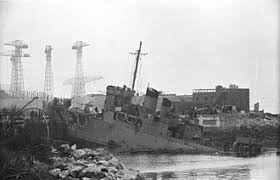
Nothing could stop the Campbelltown now and at 1.34 am the Campbelltown rammed the door and moved through the incoming water to half of the dry dock. The onboard cranes were opened and the Campeltown sank with her stern in the dock.
Gunboat MTB 74 landed at the swing bridge and shot 2 torpedoes with delayed ignition mechanism through the passage channel to the Bassin de Saint-Nazaire where they would later explode.
The biggest task of the commandos under the command of Stuart Chant was to blow up the pump house. They succeeded in placing explosives 12 meters underground. When the explosion came, large concrete blocks flew through the air. The commandos ran back to find that a few sharp blows were enough to completely destroy the pump housing and then set it on fire. In the meantime, Lieutenant Smalley and his men had succeeded in completely blowing up the windlass station.
The arrived German troops fired on the commandos and they retreated between the warehouses. Some fled towards the city to escape from there to open areas. Eventually, the group was found by a German patrol and was taken prisoner.
Another group of commandos led by Moss was blown out of their motor launch by German fire and the entire group was killed by machine gun fire. In the meantime, the motor launches picked survivors out of the water and disappeared, leaving behind about a hundred commandos. The gunboat MGB 314 survived the shelling and was the last to leave the area, the decks full of wounded men they had picked up from the water.
HMS Tynedale and Atherstone, escorted by aircraft from Coastal Command, returned safely to Falmouth. The motor fastboats ML 160, 307 and 443 also managed to return home on their own.
In the meantime, the Germans had surrounded the city so that the remaining commandos were taken prisoner of war or killed. They were gathered in a café and later 214 prisoners of war were taken to camp Stalag 133. Five commandos managed to escape and were able to flee to Gibraltar.
The explosion
Meanwhile, HMS Campeltown was still stuck in the damaged dry dock. The Germans had searched the ship but had not been able to find the explosives. At 10:35 a.m., the Campbeltown exploded, resulting in about 250 killed and wounded German soldiers and civilians. On March 30 at 4:30 p.m., the torpedoes fired by the MTB 74 exploded with delayed ignition. These explosions caused panic among the Germans. The Germans thought that the French resistance had something to do with this, so the Germans opened fire on French civilians, resulting in 16 dead and 30 wounded. Later, another 1500 French civilians were deported to an internment camp.
Victims
In the total operation, about 400 Germans were killed. The British had 169 officers and soldiers killed and 214 had been taken prisoner. 22 commandos were still able to escape with the remainder of the British flotilla to England. The five escaped commandos returned to England via Gibraltar.
Despite the large number of casualties, the Raid on Saint-Nazaire was considered one of the most successful operations. The docks were severely damaged and were still unusable until 1947.
What happened to the Bismarck, Tirpitz, Gneisenau and Scharnhorst?
After being hunted for days, the Bismarck was sunk on May 27, 1941. Around 9:00 a.m., the Bismarck was attacked by the King George V, the Norfolk, the Rodney and the Dorsetshire. 2876 shells were fired. An hour later, the order “Alle Mann von Bord” was issued. The Tirpitz was attacked in Tromso on November 12, 1944 by 29 Lancaster bombers with Tallboys and capsized. The ship was scrapped on site between 1949 and 1957. The Gneisenau was sunk in 1945 in the port of Gotenhafen. The ship was moored there to replace the 28 cm guns with 38 cm guns. It never came to that. According to Hitler, the role of the Gneisenau and the other large ships in the war was over. The 38 cm guns were now used in the coastal defense. The Scharnhorst was also pursued by the Duke of York for a long time and was eventually sunk in the Barents Sea by torpedoes from the cruisers and the accompanying destroyers.
Citation:
Wikipedia – Operation Chariot
Historiek.net – Operation Chariot
WW2 Combined Operations – Operation Chariot
Traces of War.nl
Historianet.nl
Diverse Wikipedia artikelen
Wow, fantastic blog layout! How long have you been blogging for? you make blogging look easy. The overall look of your site is excellent, as well as the content!