
In the story “The return of the Jews” we discuss extensively the problems that the Jews, who had actually survived the concentration camps in various countries, were allowed to experience.
But how were the deportations arranged at the beginning of the persecution of the Jews in countries such as the Netherlands and a number of other European countries? To make this clear, this is the story of the Jewish Council, a kind of Jewish-Dutch government that, on behalf of the Germans, ensured that the transport via Durchgangslager Westerbork went in an efficient way.
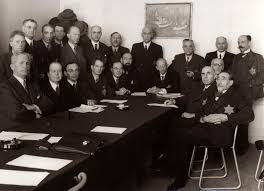
The Jewish Council of Amsterdam was established on 12 February 1941 on the orders of the German occupier. The Germans wanted to have one central point of contact for the implementation of their anti-Jewish measures.
The leadership of the Council came into the hands of Abraham Asscher, diamond merchant and chairman of the Dutch-Israelite Main Synagogue and David Cohen, professor of classical languages at the University of Amsterdam. They belonged to the elitist class of the Amsterdam Jews and were chosen by the occupier for their organizational qualities. Despite all the good intentions of the two gentlemen, the Council became an instrument of the occupier who took much work out of their hands.
The Council was initially created for the Amsterdam Jews, but later expanded into a national organization with more than 6000 employees, mainly Jews. The Council had departments such as administration, education, health care, social support, culture and emigration.
The tasks assigned to the Jewish Council were:
Conducting the orders of the Germans and communication to the Jewish community
Registering the Jews in the Netherlands
Managing the division of labour and the management of Jewish institutions
Selecting Jews for “employment in the East”, in reality the deportations to the concentration camps, via Durchgangslager Westerbork. The deportations took on a massive character in July 1942. The Jewish Council was forced to spread calls for “employment in Germany” and compile lists of those who had to leave. The Council therefore cooperated in practice in the deportation of tens of thousands of Jews. Asscher and Cohen had no real choice.
The Council showed somewhat parallel to the events in concentration camp Plaszow, where Oskar Schindler saved 1200 Jews from destruction in its factories by offering them a job and qualifying its employees as indispensable for the production of weaponry for the Nazis. The quality of the weaponry was to be desired, a lot of ammunition and other things were rejected by the Germans for poor quality. In order to save as many Jews as possible from deportation to the concentration camps, Asscher and Cohen have offered as many Jews as possible a job at the Jewish Council (Sperren). However, it became a matter of postponement and not of cancellation. At the end of the Council in September 1943, Asscher and Cohen were also eventually removed via Westerbork to Theresienstadt. They survived the war.
Abraham (Bram) Asscher
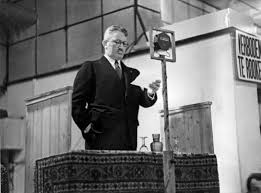
Bram Asscher was born in 1880 as a real son of Amsterdam and later became director and shareholder of the Diamond Society founded by his father and uncle. Asscher was asked for various administrative positions based on his reputation in the Jewish and non-Jewish world. Within the Jewish community he was highly valued and was extremely popular. Asscher was never afraid, did not hesitate to take difficult decisions and he never let himself be silenced. Privately, he was the uncrowned king of the Asscher family and served as an advisor, questioner and ombudsman. What Bram said was true.
David Cohen
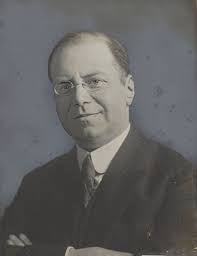
David Cohen was born in 1882 in Deventer. In 1908 he did his doctoral degree and four years later he obtained his PhD cum laude. In 1922 he was admitted as a private lecturer to Leiden University. His lectures were always full and he was loved by his students. Where Asscher was very popular with the ordinary man, Cohen focused on the elite layer of Dutch society.
Hans Böhmcker
Hans Böhmker, Beauftragte von Amsterdam, was very pleased with the initiative of Asscher and Cohen to form an authoritative body that would represent entirely Jewish Amsterdam. Asscher and Cohen also wanted to take on the chairmanship of this body. In fact, they became the mayors of Jewish-Amsterdam. The council would be extended to 20 people, mostly consisting of elite Amsterdam Jews. The Council would serve as the German occupier’s service-hatch. Every mission of the Council to the Jewish population was followed by default by the message “the Council draws your attention to the great importance involved in this task of complying immediately”.
The Jewish Council was indeed a group of friends that formed the board of the Council. They were gentlemen of the upper class, who had known each other for years. Successively, the board became more of a government and gained access to a large number of services and Jewish staff who had to perform the services. At the height, there were 8000 people of all kinds of plumage working at the Council. The policy of Asscher and Cohen was based on offering the poor mass of Jews to the Germans in order to eventually have a corps of intellectuals left, which the Jewish community could rebuild after the war. The deportation machine ran better and more smoothly in the Netherlands thanks to the Jewish Council than anywhere else in occupied Europe.
The February strike in Amsterdam
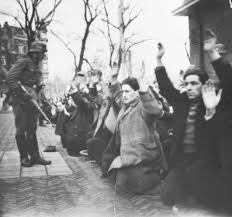
The reason for the February strike in Amsterdam was a conflict abouit an ice cream parlor of two German Jews. The day before, the windows had been smashed and the German Sicherheitspolizei suspected the ice cream parlor of hiding a Jewish resistance team, what was indeed the case. It came to a fight and the team was taken prisoner. Shooting took place on both sides. The incident was reported to SS-Brigadeführer Hanns Albin Rauter who recommended that a large raid be kept in the Jewish neighborhood. Initially, 425 young Jewish men were taken away on February 22, and the next day the raid was repeated again during the market on Waterloo Square. The prisoners ended up in Buchenwald.
The events led to a strike organised by the illegal CPN on 25 and 26 January. Because almost all populations wanted to participate, the strike took on a massive character. The German occupiers were certainly not charmed by this action of solidarity and Asscher and Cohen were called up. Both gentlemen had nothing to do with the strike, but they were threatened by Böhmcker that if the strike had not ended the next day, 500 Jewish elites would be arrested and killed. If you touched the Jewish elites of Asscher and Cohen, they touched the friends of both gentlemen. Asscher and Cohen immediately took action, resulting in the strike finally ending. So they were in fact used as strike breakers.
The End of the Jewish Council
In September 1943, when almost all Jews from the Netherlands had been deported, the Jewish Council was dissolved by the Germans. Most of the remaining employees, including Asscher and Cohen, were then deported to Westerbork and from there to Theresienstadt. Asscher and Cohen both survived the war.
After 1945, Asscher and Cohen were initially excluded from administrative positions by the Jewish community in the Netherlands because of their role in the Council. In 1950, this decision was partially reversed. The Jewish Council has since been regarded as a symbol of the tragedy of moral choices under extreme coercion; working with the Germans to prevent worse or resisting the Germans with all the consequences that entails.
The Jewish Councils in the rest of Europe
Poland: Warsaw – Judenrat led by Adam Czerniaków:
Tasks: food distribution, labor and later deportations to Treblinka
Czerniaków committed suicide when he refused to cooperate any longer
Poland: Lodz – Judenrat led by Mordecai Chaim Rumkowski
Task: organizing labour for the Germans
Lithuania: Vilnius – Vilna Judenrat led by Jacob Gens
Task: management of ghetto and law enforcement
Latvia: Riga – Riga Judenrat led by Michael Elyashov
Task: management of ghetto, labour and distribution of food
Czech Republic: Theresienstadt – Judenrat led by Jakob Edelstein, later Paul Epstein
Task: governance of the camps and ghettos, division of work, food and housing
Belarus: Minsk – Minsk Judenrat led by Eliyahu Mushkin
Task: the management of the ghettos, employment and contact with the Germans
France – Union Générale des Israelites de France (UGIF) – Raymond Raoul Lambert and Jaques Helbronner
Task: centralizing the relief effort and later the registration of Jews for deportation to the concentration camps
Hungary – Jewish Council of Budapest – Samu Stern and Ernó Petó
Task: Compiling lists for deportations and organizing ghettos
Almost everywhere the Nazis used Judenräte to have orders carried out by Jewish representatives themselves, supposedly to keep order, but in reality to organize the deportation and destruction more efficiently. The members of the Councils were in an impossible position; cooperating in deportation or refusing to cooperate with the direct death as a result and chaos for the Jewish community. The Jewish Council has existed for about 17 months.
Figures Netherlands
About 140,000 Jews lived in the Netherlands in 1940
More than 102,000 Jews were murdered in Auschwitz, Sobibor and Bergen-Belzen
Source:
The Jewish Council – Hans Knoop
Downfall – Jacques Presser
We know nothing of their fate – Bart van der Boom
I like what you guys are up also. Such intelligent work and reporting! Carry on the superb works guys I’ve incorporated you guys to my blogroll. I think it will improve the value of my website :).